Published by Ben Beveridge | October 26, 2025 | Firm News

Texas Child-Custody Appeals & Mandamus
When a Texas custody ruling goes wrong, the next step depends on the kind of order you have. Final orders can be appealed, but temporary orders generally can’t, they’re challenged by mandamus. Every appeal runs strictly on the trial record (no new evidence), under tight deadlines (often 30 days), and faces deferential standards like abuse of discretion, which makes reversals difficult.
Authored by Ben Beveridge, Family Law + Appellate attorney, The Beveridge Law Firm, PLLC (Alvin, TX).
Different types of Family Law Suits
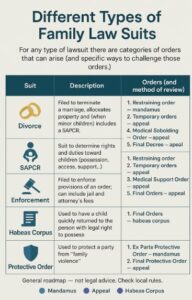
For any type of law suit there are a categories of orders that can arise (and specific ways to challenge those orders).
| Suit |
Description |
Orders (and the method of review) |
| Divorce |
Filed to terminate a marriage, typically allocates property and contains a SAPCR when minor children are involved |
1. Restraining order (mandamus)
2. Temporary orders (mandamus)
3. Wage withholding orders (appeal)
4. Medical Support Order (appeal)
5. Final Decree (appeal) |
| SAPCR (Suit Affecting the Parent-Child Relationship) |
Suit to determine rights and duties towards children (possession/access/support…) |
1. Restraining order (mandamus)
2. Temporary orders (mandamus)
3. Wage withholding orders (appeal)
4. Medical Support Order (appeal)
5. Final Orders (appeal) |
| Enforcement |
Filed to enforce provisions of an order. Can include jail time for the offender and attorney’s fees. |
1. Final Orders (habeas corpus) |
| Habeas Corpus |
Used to have a child quickly returned to the person who has a legal right to possess the child |
1. Final Orders (habeas corpus) |
| Protective Order |
Used to protect a party from “family violence”. |
1. Ex Parte Protective Order (mandamus)
2. Final Protective Order (appeal) |
Appeal vs. Review in Texas Family Law
In Texas family cases, “appeal” has a very specific meaning: it is the process for asking a court of appeals to review a final order from the trial court. But “appeal” is only one of several ways to get a higher court (or a different court) to review a ruling. Depending on your situation, the right vehicle might be:
- Appeal (of a final order): the standard path after the trial court has entered a final judgment that disposes of all parties and all claims.
- Mandamus (for temporary orders and certain extraordinary situations): an emergency, extraordinary remedy when there’s a clear abuse of discretion and no adequate remedy by appeal.
- Habeas corpus (for possession/contempt issues): used to challenge unlawful confinement or to enforce immediate possession in certain parent–child cases.
- Restricted appeal / bill of review (for defaults or when you didn’t participate): limited avenues to set aside certain judgments when strict criteria are met.
- De novo hearing (from an associate judge to the referring district court): not technically an “appeal” to a higher appellate court, but a fresh look by the district court on issues first heard by an associate judge.
Why the distinction matters: the vehicle you choose controls deadlines, what must be included in the record, which legal standards apply, and your realistic odds of success. Calling everything an “appeal” is how deadlines get missed and cases get dismissed. Step one is identifying what kind of order you have and which review path applies.
Final vs. Temporary Orders (What’s Actually Appealable)
Only final orders are appealable. Temporary orders generally are not; they’re reviewed (if at all) by mandamus. Getting this line right is critical, because filing a notice of appeal from a non-final order can waste time and money and may lead to dismissal.
Finality isn’t about how the order feels; it’s about what the order says and does. A final order must clearly dispose of all claims and all parties. Temporary orders, by contrast, keep the case moving and set rules while the case continues, but they’re not the court’s last word.
How to tell if your order is final (quick checklist)
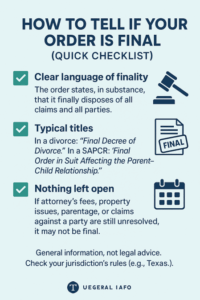
- Clear language of finality. The order states, in substance, that it finally disposes of all claims and all parties.
- Typical titles. In a divorce: “Final Decree of Divorce.” In a SAPCR: “Final Order in Suit Affecting the Parent-Child Relationship.”
- Nothing left open. If attorney’s fees, property issues, parentage, or claims against a party are still unresolved, it may not be final.
If any of that is missing or unclear, talk to counsel before you file, appeals from non-final orders are typically dismissed, abated, or sent back until the trial court finishes.
Effects of a final order (what people often miss)
- Temporary orders end. A final order replaces any temporary orders that came before it.
- No automatic pause. Filing an appeal does not automatically suspend a final order. Unless there’s a proper suspension or supersedeas, the order remains enforceable while the appeal is pending.
Mandamus for Temporary Orders (When You Can’t Wait)
When a temporary order is causing immediate harm, or when waiting for a final judgment would leave you without a meaningful remedy, mandamus may be the right tool. Mandamus asks the appellate court to step in now, but it’s a high bar and is granted only in limited circumstances.
To win mandamus relief, the relator (the party seeking relief) generally must show:
- the trial court clearly abused its discretion, and
- there’s no adequate remedy by appeal (which is often true for temporary orders in custody cases).
Mandamus also comes with a practical timing rule: equity aids the diligent. If you delay unreasonably and that delay harms the other side or the process, the court can deny relief under laches. File promptly.
Mandamus quick screen
- Did the trial court act without reference to guiding principles or in a way that’s clearly arbitrary/unreasonable?
- Will a regular appeal later be an inadequate fix (for example, because the damage to parent-child time is immediate and can’t be undone)?
- Have you moved quickly (so laches won’t sink your request)?
- Do you have a clean, well-organized record showing exactly what happened?
What to expect
Mandamus is usually faster than a traditional appeal, but it’s still a written proceeding. The court reviews filings and the supporting record; it can deny without a response. Even strong petitions are sometimes denied, so treat mandamus as targeted relief for exceptional situations, not a routine second bite at the apple.
Appeal vs. Mandamus (Quick Compare)
| Feature |
Appeal |
Mandamus |
| When It’s Used |
After a final order is signed |
During a pending case (e.g., to challenge temporary orders or jurisdictional rulings) |
| Purpose |
Ask a higher court to correct reversible error in the final judgment |
Ask a higher court to correct a clear abuse of discretion when there’s no adequate remedy by appeal |
| Evidence |
Record-only (no new evidence) |
Record-based; includes a mandamus appendix; still no new evidence |
| Timing |
Strict deadlines (often 30 days for the Notice of Appeal) |
Prompt filing expected; delay can trigger laches |
| Speed |
Typically slower (months) |
Typically faster, but granted sparingly |
| Possible Results |
Affirm, modify, reverse, or remand |
Grant or deny the writ; targeted relief |
| Effect on Orders |
Filing an appeal does not automatically stay the order |
Relief, if granted, can halt or direct trial-court action immediately |
Ways to Change an Order That Aren’t Appeals
Appealing isn’t the only way to change a court’s order. Depending on timing and facts, one of these may be better:
- Modification (Final Orders): If there’s been a material and substantial change in circumstances and the change is in the child’s best interest, the court can modify conservatorship, possession, and support terms.
- Motion for New Trial (Final Orders): Within the trial court’s plenary power window, the judge can set aside the judgment and grant a new trial for specific reasons. This is not an appeal but can reset the case in the trial court.
- Clarification (Enforcement context): If a provision is too vague to enforce by contempt, the court can clarify it, but cannot make substantive changes under the guise of clarification.
- Judgment Nunc Pro Tunc: Fixes clerical errors in a judgment at any time. It cannot be used to make substantive changes.
When these make more sense than appealing
- You need a faster or narrower fix than an appeal can offer.
- You missed the appellate deadline but still qualify for a trial-court remedy.
- The problem is post-judgment clarity or a clerical mistake, not reversible legal error.
- Facts have changed since the final order (modification) rather than the trial court committing appealable error at the time of judgment.
Should I Appeal? The Error–Preservation–Harm Triad
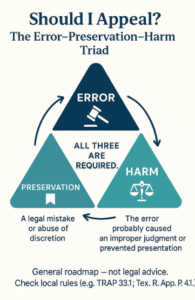
Winning on appeal is about more than disagreeing with the outcome. Texas appellate courts look for three things:
- Error — The trial court legally erred (misapplied the law, admitted/excluded evidence improperly, entered findings unsupported by legally sufficient evidence, etc.).
- Preservation — You preserved that error in the trial court, usually by making a timely, specific objection and obtaining a ruling (or objecting to a refusal to rule). See Texas Rule of Appellate Procedure 33.1.
- Harm — The error probably caused the rendition of an improper judgment or probably prevented you from properly presenting the case on appeal. See TRAP 44.1.
Most potential appeals falter on preservation or harm, not because no error occurred, but because it wasn’t preserved correctly or it didn’t change the outcome.
A quick self-screen before you invest
- What exactly was the legal error? Name the rule, statute, or case the court misapplied.
- Where is it in the record? Identify the page/line in the clerk’s record (CR) or reporter’s record (RR) showing your objection and the court’s ruling.
- How did it matter? Tie the error to a finding, conclusion, or part of the decree that would likely have been different.
Standards of review (the uphill grade you’re climbing)
Even with preserved, harmful errors, your odds depend on the standard of review. Pure legal questions get de novo review, but most family-law rulings fall under abuse of discretion, which is difficult to overcome and affords the trial court considerable leeway. Understanding the standard helps set expectations and shapes your briefing strategy.
Finally, remember that appeals are record-only, no new evidence comes in. If critical facts never made it into the record, an appeal can’t fix that. In some situations, your better path is a modification case to present new, post-judgment facts rather than an appeal aimed at the old record.
Standards of Review (De Novo vs. Abuse of Discretion)
Not every issue is reviewed the same way on appeal. The standard of review sets the court’s “error-tolerance” and often decides who wins.
Abuse of Discretion (most family-law issues)
This is the workhorse in custody, support, visitation, possession schedules, maintenance, and many property decisions. The question isn’t “Would the appellate court have ruled differently?” It’s whether the trial judge acted without reference to guiding principles or made an arbitrary/unreasonable call. If there’s a reasonable basis in the record, the ruling usually stands, even if the appellate court might have decided another way.
De Novo (pure law and jurisdiction)
Questions like statutory interpretation, jurisdiction, and standing get no deference. The appellate court decides the legal question fresh. If your issue is truly legal (not fact-heavy or discretionary), de novo is the friendliest standard for appellants.
Evidence sufficiency (as a component)
In family cases, sufficiency complaints often ride inside the abuse-of-discretion analysis. Practically, you’ll argue the court misapplied the law or reached a decision unsupported by the evidence while staying within the “abuse” framework.
Identify the standard for each issue before you draft. It shapes your arguments, the level of detail you need from the record, and your expectations about odds.
How to Start a Texas Child-Custody Appeal (Step-by-Step)
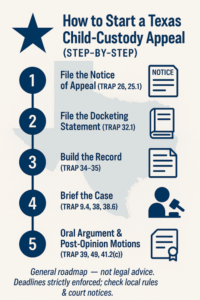
Appeals run on deadlines and records. Missing a step can sink your case even if you’re right on the law.
Step 1: File the Notice of Appeal (TRAP 26, 25.1)
- When: Generally 30 days from the date the final order is signed. If a timely motion for new trial or certain post-judgment requests are filed, deadlines may extend (commonly to 90 days).
- Where: With the trial-court clerk in the county where your case was heard (serve all parties).
- What to include: Case style and number, trial court and judge, date of the judgment/order, a statement of intent to appeal, and the parties’ names. Use e-filing if available.
Tip: Calendar the deadline the day the order is signed. Don’t wait to obtain the file-stamped copy to start.
Step 2: File the Docketing Statement (TRAP 32.1)
- The court of appeals requires a docketing statement with party/contact information, a short case description, and whether the record includes reporter’s transcripts.
- File promptly after the notice, following your court of appeals’ forms and instructions.
Step 3: Build the Record (TRAP 34–35)
- Clerk’s Record (CR): The pleadings, orders, findings, and exhibits filed with the clerk. Designate specifically what you want included; don’t rely on a generic “everything” request.
- Reporter’s Record (RR): Transcripts of hearings/trial. Contact the court reporter immediately to arrange payment and timelines. Identify dates of all relevant hearings.
- Supplementation: If something was omitted, you can request a supplemental record, but that takes time. Get it right the first time.
No new evidence: The appellate court only sees what’s in the CR and RR. If it’s not in the record, it doesn’t exist for your appeal.
Step 4: Brief the Case (TRAP 9.4, 38, 38.6)
- Appellant’s Brief: States your issues, standards of review, facts with record citations, and argument with authorities. Mind the formatting and word limits (principal briefs commonly capped around 15,000 words; replies around 7,500).
- Appellee’s Brief: Filed by the other side.
- Reply Brief: Optional but useful to address new arguments and tighten the dispute.
- Deadlines: The briefing clock runs from when the record is complete. Track the court’s notices.
Structure that works:
- Issues presented (short and focused)
- Standards of review (per issue)
- Statement of facts (neutral tone, pinpoint citations)
- Summary of the argument
- Argument (authorities + record cites + harm analysis)
- Prayer for relief
Step 5: Oral Argument and Post-Opinion Motions (TRAP 39, 49, 41.2(c))
- Oral argument is discretionary. Request it, but be ready for submission on the briefs.
- After the opinion, consider a motion for rehearing or en banc rehearing if the panel overlooked/ misapprehended a key point. Be surgical and timely.
- If appropriate, explore further review. Be realistic about costs, timelines, and the narrow grounds typically accepted.
Costs, Risks, and Local Considerations (Brazoria & Galveston)
Appeals are investments. Set expectations early.
Typical cost drivers:
- Reporter’s Record: Often the largest expense—multi-day hearings can run to the thousands depending on length and number of exhibits.
- Clerk’s Record: Usually hundreds to $1,000+, depending on volume.
- Filing and service: Court fees, e-filing service, copy costs.
- Attorney time: Issue selection, record review, and briefing are intensive.
Timing:
- From notice of appeal to decision, many custody appeals take months; a year is not unusual depending on record size, briefing extensions, and the court’s docket.
Presumptions and practical risks:
- The judgment is presumed correct; you must demonstrate preserved, harmful error under the proper standard of review.
- Appealing does not automatically pause enforcement of a final order. You may need a stay or supersedeas depending on the relief and posture.
- Local logistics matter: In Brazoria and Galveston County cases, line up court-reporter availability early, verify which hearings were recorded, and confirm clerk procedures for record designation and supplementation.
When to reconsider an appeal:
- If the key facts you need aren’t in the record.
- If your strongest complaints were not preserved.
- If a modification case (new facts; best-interest analysis) is a better tool than trying to reverse a discretionary call on a cold record.
Why Hire a Family-Law Appellate Specialist
Local practices can affect how quickly you can locate the right court reporter, how fast the record can be prepared, and how dockets are managed. Those details matter when you’re racing a deadline, coordinating a mandamus, or triaging which issues to press on appeal.
At The Beveridge Law Firm, PLLC in Alvin, we focus on family law and appellate work for Brazoria and Galveston families, with a particular commitment to non-custodial parents (including fathers). Because we handle both trial-level family matters and appeals, we help clients think two steps ahead, preserving error at trial, building the appellate record, and selecting the right vehicle (appeal vs. mandamus) for the situation.
What to bring to your consult:
- The signed final order (and date), plus any temporary orders still causing problems.
- A list of the objections you made and how the court ruled.
- The hearing/trial dates and any post-judgment filings.
- The court reporter’s name/contact (if you have it).
- Any deadlines already on the calendar.
We’ll assess whether you have preserved, reversible issues, discuss timing and budget, and outline a plan that fits your goals and the realities of appellate review.
Do You Need to Act Now? (30-Day Rule & Urgent Mandamus)
- If your final order was just signed, your notice of appeal deadline is typically 30 days. Waiting risks jurisdiction.
- If a temporary order is the issue, you may need a mandamus petition, there’s no fixed deadline, but delay can trigger laches. Move quickly.
Ready to Talk?
Call (281-407-0961) to schedule a consultation, or send the signed order and your key hearing dates through our contact form. We’ll confirm deadlines, map the correct review path (appeal vs. mandamus), and outline next steps to protect your rights.

Frequently Asked Questions
Can you appeal temporary orders in Texas?
No. Temporary orders are not appealable. If the order is causing immediate, irreparable harm and there’s no adequate remedy by appeal, your option is typically mandamus, an extraordinary proceeding with a high bar that must be pursued promptly.
What makes an order “final” for appeal?
Clear, unequivocal language that disposes of all claims and all parties. Typical titles include Final Decree of Divorce or Final Order in SAPCR. If anything material is left unresolved, the order may not be final and a traditional appeal may be premature.
Do appeals allow new evidence?
No. Appeals are decided on the trial-court record: the Clerk’s Record and Reporter’s Record. You won’t get to add documents or testimony that weren’t presented below.
What are strong grounds for appeal?
Preserved legal errors that probably affected the outcome, such as misapplied law, improper admission or exclusion of key evidence, or findings unsupported by the record under the governing standard of review.
How long does a custody appeal take?
Expect months. Many cases resolve somewhere in the 6–12 month range, depending on record size, briefing schedules, and the court’s calendar. Some move faster; complex matters can take longer.
Does filing an appeal pause my obligations?
Generally no. A final order remains enforceable unless properly stayed or superseded. If you need relief from enforcement during the appeal, raise it with your attorney right away.
Important Disclaimer: This article is general information, not legal advice. Reading it does not create an attorney–client relationship. Appellate deadlines are strict, and remedies depend on your specific facts and record. For advice about your case, consult a licensed Texas attorney as soon as possible.