Published by Ben Beveridge | November 3, 2025 | Firm News
Quick answer: In Texas custody cases, a judge can give one parent exclusive authority, require both parents to agree (often with a medical tie-breaker), or allow each parent to act independently on psychological/psychiatric care. The court chooses the model that best serves the child’s interests based on evidence of co-parenting, treatment history, and provider input.
Who Decides a Child’s Therapy in Texas? Understanding the Right to Make Psychological & Psychiatric Decisions
Updated: November 2, 2025 • Texas Family Law
Ben Beveridge, State Bar No. 24121457, 1600 East Highway 6, Suite 225, Alvin, Texas 77511, (281) 407-0961
Quick Primer: Why this right matters
*note, rights are just one consideration in a child custody order there’s also support, possession and access, geographic restriction. Here is a list of all the provisions typically included in an order.
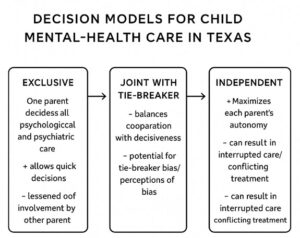
When a child needs counseling, testing, medication, or inpatient care, who gets to decide can be outcome-determinative. Texas courts can:
(1) give one parent the exclusive right to consent to psychological and psychiatric treatment;
(2) require joint decisions (with or without a tie-breaker); or
(3) allow parents to act independently with conference/notice duties.
The allocation depends on what the Court believes is in the best interest of the child which ultimately depends on the evidence you present to the Court.
You got to FIGHT, for your RIGHT…….sometimes
The Texas Family Code groups a conservator’s/parent’s rights into different categories and indeed, in an order, the rights are grouped into the same categories. A party who is deciding what approach to take regarding the allocation of parental rights would be well informed to know that some rights are almost never fought over, some of them are sometimes fought over and others are commonly litigated. Accordingly, if a parent makes a request to limit the other parents rights, the requesting parent should know that some requests are common and won’t alarm the judge but if a parent ask to limit the other parents rights which are rarely litigated, the court will expect to see good cause for the request and may begin to suspect the requesting parent is excessively litigious or contentious if good cause is not shown. As will be discussed later, causing the judge to suspect that one parent is especially contentious can be a cause for limiting that parent’s rights to the child.
These rights MUST be allocated
Whether the parents submit an agreed parenting plan or the parents can’t agree and the court must decide, all of these rights must be allocated and specified in a court order. Texas Family Code 153.132,153.133 and 153.134

Rarely litigated rights and duties.
The following rights and duties are rarely litigated as allowing a parent to have these rights and duties typically can’t adversely affect a child even if the parent who has these rights and duties doesn’t make the best decisions for the child.
Sec. 153.073. RIGHTS OF PARENT AT ALL TIMES.
*here’s a more comprehensive blog on all the rights and duties that can be allocated in a child custody order.
This section of the family code mandates that at all times parents have the following rights not, not all rights under this section have been included, only those which could be relevant to psychological/psychiatric rights**
(1) the right to receive information about the child’s health, education, and welfare.
(2) the right to confer with the other parent before decisions about the child’s health, education, and welfare.
(3) the right to access the child’s medical, dental, psychological, and educational records.
(4) the right to consult with the child’s physicians, dentists, and psychologists.
…
(8) the right to consent to emergency medical, dental, or surgical care when there’s immediate danger.
…
*NOTE* These are rights, they do not impose duties on the other parent to do anything. I sometimes have clients wanting me to bring an enforcement against the other parent for not providing information about the child’s “health, education, and welfare” under this provision, but this provision does not state the other parent has a duty to provide the information. However, there may be other provisions in the order are that enforceable regarding the sharing of information. What a parent can do with this information is provide it to a school or treating physician to prove they have rights to receive information or consult with the physician. https://beveridgelawfirm.com/visitation-enforcement/
Sec. 153.074. RIGHTS AND DUTIES DURING PERIOD OF POSSESSION.
Unless limited by court order, a parent appointed as a conservator of a child has the following rights and duties during the period that the parent has possession of the child:
(1) the duty of care, control, protection, and reasonable discipline of the child;
(2) the duty to support the child, including providing the child with clothing, food, shelter, and medical and dental care not involving an invasive procedure;
(3) the right to consent for the child to medical and dental care not involving an invasive procedure; and
….
Most parents have these rights, these are rarely limited. Its not uncommon for a parent to contact me and want to modify his current court order because he does not the right to make medical decisions. But upon further inspection, that parent does not have the right to make “invasive medical” medical decisions but still, under this provision, does in fact have the right to consent to medical care.
Commonly litigated rights and duties
The most commonly litigated right is the exclusive right to determine the primary residence of the child. This is what parents fight over when they fight over “custody”. So it’s not unusual at all to see/hear parents fight over this right.
Sec. 153.134. COURT-ORDERED JOINT CONSERVATORSHIP. (a) If a written agreed parenting plan is not filed with the court, the court may render an order appointing the parents joint managing conservators only if the appointment is in the best interest of the child, considering the following factors:
…
(b) In rendering an order appointing joint managing conservators, the court shall:
(1) designate the conservator who has the exclusive right to determine the primary residence of the child and:
…
So, there are some rights that are not usually fought over, one that is usually fought over, and then a handful of rights which are sometimes fought over. These are the rights that practitioner’s call the “heads, eds and meds”. That is, the right to make psychological/psychiatric decisions, educational decisions and invasive medical decisions.
Sec. 151.001. RIGHTS AND DUTIES OF PARENT. (a) A parent of a child has the following rights and duties:
…
(6) the right to consent to the child’s marriage, enlistment in the armed forces of the United States, medical and dental care, and psychiatric, psychological, and surgical treatment;
…
(10) the right to make decisions concerning the child’s education;
Definitions “Psychological” vs. “Psychiatric”

The main essential difference here between psychiatry and psychology is that psychiatrist can prescribe medication whereas psychologist generally provide non-medication based treatment (therapy, counseling..). The Appellate Court for Harris, Brazoria and Galveston County (the 14th Judicial District Appellate Court) has found that the family code allocates Psychiatric and Psychological rights as distinct right and noted that, specifically, psychiatric rights can be contained under the umbrella of medical rights (another distinct right):
Texas custody orders often separate these terms because statutes expressly list the right to consent to psychiatric and psychological treatment as a distinct, allocable parental right. However, “common parlance places the phrase “psychiatric treatment” within the meaning of or as a type of “medical treatment”, and yet “psychiatric treatment” is also closely related but distinguishable to “psychological treatment.” Donnelly v. Speck, 667 S.W.3d 885, 889 (Tex. App. 2023)
- Psychiatry is the medical practice of mental health by a physician (M.D. or D.O.) who can diagnose, prescribe, and direct medical treatment, including hospitalization.
- Psychology is the licensed practice of psychology (testing, diagnosis within scope, psychotherapy) by psychologists and related licensees under the Psychologists’ Licensing Act.
In practice, the rights to make psychological and psychiatric rights are normally grouped together and even included in the same sentence in the order which allocates those rights. However, it is not unusual to see the rights characterized and allocated differently. The most common demarcation I have seen is allowing parents to have the independent right to make psychological decisions (consent to therapy..) but make the right to consent to psychiatric decisions (where medication may be involved) a joint right.
If both parents are conservators, the court must specify which rights are exercised independently, jointly, or exclusively. This includes the psychological/psychiatric decision right.
Sec. 153.071. COURT TO SPECIFY RIGHTS AND DUTIES OF PARENT APPOINTED A CONSERVATOR. If both parents are appointed as conservators of the child, the court shall specify the rights and duties of a parent that are to be exercised:
(1) by each parent independently;
(2) by the joint agreement of the parents; and
(3) exclusively by one parent.
When SMC/PC Changes the Analysis
The type of conservatorship ordered affects your options regarding rights and duties. Parents are either both appointed joint managing conservators or one is a Sole managing conservator and the other is a Possessory conservator. The presumption is that the parties are appointed joint managing conservators (TFC 153.131) and that the Court then allocate the rights and duties between the parties (TFC 153.073). However, if the parties are appointed Sole managing/ Possessory managing conservator, then the court does not allocate the rights, all rights go to the Sole managing conservator.
Although the issue of who may be appointed a joint managing conservator, like other areas of the law, can be extremely complicated and nuanced, and this blog is not intended to delve too deeply into the nuances, below is a condensed table that a litigant can use to help determine whether the parties will be appointed joint managing conservators or not.
| Court may not appoint parties Joint Managing Conservators |
credible evidence is presented of a history or pattern of past or present child neglect, or physical or sexual abuse by one parent directed against the other parent, a spouse, or a child 153.004b |
| Court not required to appoint parents as joint managing conservators |
court finds that appointment of the parent or parents would not be in the best interest of the child because the appointment would significantly impair the child’s physical health or emotional development
TFC 153.131. |
| Presumption in favor of joint managing conservators is removed |
A finding of a history of family violence involving the parents of a child. TFC 153.131b |
| Factors the court MUST consider when making an appointment |
(1) a party engaged in a history or pattern of family violence, as defined by Section 71.004;
(2) a party engaged in a history or pattern of child abuse or child neglect; or
(3) a final protective order was rendered against a party.
TFC 153.005c |
| Requirements to be appointed joint managing conservators |
The appointment is in the best interest of the child, considering the following factors:
(1) whether the physical, psychological, or emotional needs and development of the child will benefit from the appointment of joint managing conservators;
(2) the ability of the parents to give first priority to the welfare of the child and reach shared decisions in the child’s best interest;
(3) whether each parent can encourage and accept a positive relationship between the child and the other parent;
(4) whether both parents participated in child rearing before the filing of the suit;
(5) the geographical proximity of the parents’ residences;
(6) if the child is 12 years of age or older, the child’s preference, if any, regarding the person to have the exclusive right to designate the primary residence of the child; and
(7) any other relevant factor.
TFC 153.134a |
Psych Rights Sole Managing Conservator (SMC):
- An SMC (sole managing conservator), by statute, has several exclusive rights, including the exclusive right “to consent to psychiatric and psychological treatment.” Thus, when the parties are not joint managing conservators, this right is not litigated because it automatically goes to the Sole managing conservator.
Sec. 153.132. RIGHTS AND DUTIES OF PARENT APPOINTED SOLE MANAGING CONSERVATOR. Unless limited by court order, a parent appointed as sole managing conservator of a child has the rights and duties provided by Subchapter B and the following exclusive rights:
(1) the right to designate the primary residence of the child;
(2) the right to consent to medical, dental, and surgical treatment involving invasive procedures;
(3) the right to consent to psychiatric and psychological treatment;
…
Psych Rights for Joint Managing Conservators (JMC):
With JMC’s (the presumption in Texas) things can get tricky. Contrary to popular belief, when parents are appointed JMC’s, essentially all it means is now the court can allocate the rights and duties as the court sees fit (not that the rights are evenly allocated). The Court can appoint the parties as JMC’s and give all the rights exclusively to one parent, without abusing its discretion. More commonly though the rights and duties are split one of two ways, jointly or independently. The possible options the court can order are:
- one parent has the exclusive right to make decisions;
- the parents both have independent rights; or
- the parents both have joint rights.
A) Joint managing conservators, Option 1: Exclusive right to make psychological/psychiatric decisions
What it means: One parent has the right to make psychological/psychiatric decisions and the other parent has no right to make such decisions nor veto such decisions.
Prevalence: least common method of allocating rights for joint managing conservators.
When used: Persistent conflict, a showing of a history of bad decision making regarding psychological/psychiatric decisions, demonstrated inability to reach shared decisions, live very far from the child, does not visit the child.
Options: this method of allocating rights commonly has the requirement that the parent with the exclusive right consult with the other parent before making such decisions. This way the other parent can have input before the decision is made and can be informed about decisions that are made, even though they can’t actually make the decisions.
Common Drafting Language:
Exclusive right without consultation
[“IT IS ORDERED that [parent], as a parent joint managing conservator, shall have the following rights and duty:…
- the exclusive right to consent to psychiatric and psychological treatment of the children;”]
Exclusive right with consultation
[“IT IS ORDERED that [parent], as a parent joint managing conservator, shall have the following rights and duty:…
- the exclusive right after meaningful consultation with the other parent to consent to psychiatric and psychological treatment of the children;”]
[“IT IS FURTHER ORDERED that, [parent with exclusive right] shall have the following exclusive rights regarding the children, with [parent without right] to be consulted in each matter for cooperative co-parenting:….
- The right to consent to psychiatric and psychological treatment of the children.”]
B) Joint managing conservators, Option 2: Joint right to make psychological/psychiatric decisions
What it means: Here, both parents have to make decisions together and if both parents don’t agree on a psychological/psychiatric decision, then the care provider is not supposed to provide such treatment. Since there is a potential that the parties won’t agree and then no treatment can be provided, there is often a “tie breaker” appointed to prevent such situations.
Prevalence: This is the means of allocating rights that I see as most common. As long as there is not a huge amount of parental conflict this option can work and it supports/requires both parents to be involved in psychological/psychiatric decisions for their child.
When used: Parents can often collaborate but stalemates may sometimes occur.
Options: Here, the most common option is to appoint a “tie-breaker” in case the parents can’t come to a decision. It’s important to note that since the tie-breaker is not a party they are not actually ordered to do anything and can simply choose not to be a tie-breaker. There have been cases where the tie-breaker does not want to become involved in parental drama and they simply opt out. The tie-breaker for psychological/psychiatric rights is often the child’s primary care provider or treating physician.
Common Drafting Language:
[IT IS ORDERED that [parent a] and [parent b], as parent joint managing conservators, shall each have the following rights and duties:
….
- the right, subject to the agreement of the other parent, to consent to psychiatric and psychological treatment of the child, provided that, if the parents are unable to agree, they will defer to the recommendation of the child’s primary care physician;]
C) Joint managing conservators, Option 3: Independent right to make psychological/psychiatric decisions
What it means: Here, both parents are given the “independent” right to make psychological/psychiatric decisions which means both parties consent is not needed, either party can make and consent to psychological/psychiatric decisions on their own, without the other parents agreement or consent (even without the other parents knowledge in some cases). Its important to note here that just because one parent has the independent right to make decisions a treating physician may require both parents consent as part of the treating physician normal policy.
Prevalence: I believe this is the second most common way to allocate psychological/psychiatric decisions. When the parents can coparent well enough that rights are shared, they usually want joint rights so that they are both informed and the other parent does not make unilateral decisions without them.
When used: Low conflict; both parents need flexibility (e.g., scheduling counseling during their periods of possession) without unilateral major changes.
Options: It’s not unusual to see this right coupled with a requirement to consult with the other parent before making decisions so the other parent is informed.
Common Drafting Language:
[IT IS ORDERED that [parent A] , as a parent joint managing conservator, has the following additional rights with respect to the child:…
- The independent right to consent to psychiatric and psychological treatment;]
D) Joint managing conservators, Option 4: Independent right to make psychological decisions and Joint right to make psychiatric decisions
What it means: this option essentially give the parents the independent right to consent to therapy and other non-medical mental health treatment but requires both parents agreement to allow psychiatric care which can involve medication.
Prevalence: I rarely see this used but I believe it would be a good option for parents who get along relatively well.
When used: Therapy decisions are frequent and time-sensitive; medication decisions need extra guardrails.
Options: As with any joint right, the joint right to make psychiatric decisions would involve a tie-breaker.
Common Drafting Language:
No Examples.
Best-Interest Evidence That Moves Judges
This section is for parents who are appointed joint managing conservators and presumably know how the right to make psychological and psychiatric decisions should be allocated (exclusive, independent or joint). So now the questions are:
- if the parents disagree about how the right should be allocated, how does the court decide who is right;
- what is the legal standard set by the legislature and utilized by the courts; and
- what type of evidence is required to argue for certain types of allocations.
Best Interest of the Child
With most decisions regarding children (conservatorship, possession and access, support…) the primary consideration and legal standard is what is in the best interest of the child. The Texas legislature has written statutes which direct the Courts to do what is in the “Best Interest of the Child” when making conservatorship decisions and indeed, the appellate court typically won’t reverse a trial court’s decision if it finds the court attempted to act in the best interest of the child.
Texas Legislature directive to Texas Courts concerning Conservatorship Decisions.
Sec. 153.002. BEST INTEREST OF CHILD; REBUTTABLE PRESUMPTION IN SUIT BETWEEN PARENT AND NONPARENT. (a) The best interest of the child shall always be the primary consideration of the court in determining the issues of conservatorship and possession of and access to the child.
Texas Appellate Court’s refer to the “best interest of the child” when reviewing a trial court’s decision.
In Brazoria County’s 300th District Court, exclusive rights to make psychological and psychiatric decisions were given to a mother and father appealed. The Court found that father and daughter were in regular conflict and although father had sincere concern for daughters health the court found his intervention would be inappropriate. Therefore the appellate court concluded that the trial court’s decision was in the best interest of the child.
Donnelly v. Speck, 667 S.W.3d 885 (Tex. App. 2023)
How is the best interest standard applied to psych rights?
Stating that the court should do what is in the best interest of the child sounds vague and leaves plenty of room for the judge to do just about anything as long as the judge finds it to be in the best interest of the child, and indeed the judge’s do a tremendous amount of discretion in family law cases when the best interest of the child is at issue. But there is some guidance. Texas cases have provided some factors for the court to consider and a party who is preparing to argue for what is in the child’s best interest should consider these factors.
- Child’s Physical and Emotional Needs: Prioritizing health, safety, stability, and overall development.
- Stability of the Home Environment: Ensuring a stable home, reliable job, and dependable child care.
- Parental Ability: Assessing each parent’s ability to meet the child’s needs.
- Maintaining a Relationship with Both Parents: Courts favor meaningful relationships with both parents, discouraging alienation.
- Danger to the Child: Addressing issues of substance abuse or abuse, with documentation as supporting evidence.
- Parental Involvement with the Child: Considering the level of involvement in the child’s life, recognizing the primary caregiver.
- Community and Family Support: Preference for proximity to both parents and extended family.
- Child’s Preferences: From age 12, the court may consider the child’s preferences, but it’s not binding.
Holley v. Adams, 544 S.W.2d 367, 371–72 (Tex.1976)
This paper is not a deep dive in the best interest of the child but more info can be found here: https://beveridgelawfirm.com/child-custody-in-texas-understanding-the-best-interest-standard/
So, a parent who wants to argue that a particular arrangement concerning psychological and psychiatric rights is in the best interest of the child should look at each factor and see if the factors weigh in favor of their positions. But even with the factors, there is much room for disagreement. The strongest argument that a given position is in the best interest of the child is to find appellate cases that support your positions. These will be cases where an appellate court has reviewed a trial court’s decision concerning psychological and psychiatric rights in light of the best interest of the child standard.
| Case Name |
Evidence/Arguments in favor of granting exclusive rights to one parent |
| Int. of A.P.L., No. 01-23-00725-CV, 2025 WL 2412903 (Tex. App. Aug. 21, 2025) |
1) Tie-breaker was not working (more than one of the tie-breaking doctors declined to break ties or continue with care for the children because of Mother’s and Father’s acrimony)
2) parties having trouble effectively co-parenting, communicating, or reaching shared decisions |
| Swaab v. Swaab, 282 S.W.3d 519 (Tex. App. 2008) |
1) Expert recommended to the trial court that it grant mother the exclusive right to make psychological choice
2) Child has need for psychological care (adhd, ocd, bipolar disorder) |
| Donnelly v. Speck, 667 S.W.3d 885 (Tex. App. 2023) |
1) Father and Daughter were in greater regular conflict.
2) Father admitted to recommending that Daughter be arrested.
3) Father also had a physical altercation with Daughter.
4) Daughter testified that Father was disruptive to her life.
5) Father was likely to intervene inappropriately in Daughter’s care |
| Baltzer v. Medina, 240 S.W.3d 469 (Tex. App. 2007)
|
1) The record contains evidence demonstrating dad’s commitment to child’s well-being and education and mom’s indifference or non-responsiveness to some of S.M.’s needs in these areas. |
| Flowers v. Flowers, 407 S.W.3d 452 (Tex. App. 2013) |
(1) There was bad blood and failure to communicate between Mom and Dad.
(2) After the divorce, they communicated only by email due to interaction difficulties.
(3) An incident led to a two-year protective order against Dad.
(4) After that incident, the parties stopped communicating altogether.
(5) Mom’s parents facilitated Dad’s pick-ups and returns of the children.
(6) Out of distrust, Mom often recorded her interactions with Dad.
(7) Dad admitted he routinely avoids interacting with Mom unless necessary. |
Practical Evidence Checklists (what moves the needle)
The evidence that tends to move courts in favor of granting one parent the exclusive right to make psychological/psychiatric decisions are:
- Repeated impasses delaying treatment; missed or sabotaged appointments; provider withdrawals due to conflict.
- Inconsistent medication or refusal to follow treatment recommendations.
- One parent’s established track record managing providers, evaluations, and insurance; the other parent’s non-cooperation.
- Expert/provider testimony that delay or inconsistency harms the child.
Authorities allow trial courts to award exclusive decision-making where joint decision-making is unworkable and contrary to best interest.
To resist an exclusive right, emphasize:
- Successful co-parenting on health issues;
- prior joint decisions;
- prompt communication;
- no evidence of harm from joint control; and
- A workable tie-breaker (treating psychiatrist/psychologist or pediatrician) to preserve shared rights while preventing stalemate
The TIE Breaker you need to know when arguing best interest of the child- Policy Arguments
Its easy to image both parents coming up with argument, utilizing the best interest of the child standard, that both support the position. For example. One parent argues that both parents have historically been involved in making decisions for the child (Stability and Parental involvement argument) and the other parent argues that the make better decisions for the child and that recent arguments have caused issues making decisions for the child (making parental ability and child’s physical needs arguments). So now what? Now, go one level up and make a policy argument. Policy arguments are general legislative goals that statutes are supposed to meet, so if there is a question about how a statue should be argued or interpreted, one should always look to see if policy favors your argument. Lucky for someone arguing that the parents should share rights, that is Texas policy!
- Public policy: Texas encourages children’s continuing contact with fit parents and encourages parents to share rights and duties.
Sec. 153.001. PUBLIC POLICY (a) The public policy of this state is to:
(1) assure that children will have frequent and continuing contact with parents who have shown the ability to act in the best interest of the child;
(2) provide a safe, stable, and nonviolent environment for the child; and
(3) encourage parents to share in the rights and duties of raising their child after the parents have separated or dissolved their marriage.
Steps to Litigate This Issue (Checklist)
This roadmap is written for Texas family cases and is general information, not legal advice. Consult a qualified attorney about your specific facts.
1) Determine conservatorship status early
- Are the parties Joint Managing Conservators (JMC) or ss one a Sole Managing Conservator (SMC) and the other a Possessory Conservator (PC)?
- JMC → Move to step 2
- SMC/PC → there’s not a lot of options here. If you are PC just try to have notice and consult provisions so that even though you can’t make decisions, you can at least be informed.
- If the parties are (or are likely to be) Joint managing Conservators, define exactly what you want
- Decide what type of allocation are in the best interest of your child (exclusive, independent or Joint)
- If exclusive, consider the requirement of the parent with exclusive rights having to confer/consult with the other parent before making decisions
- If Independent, also consider the requirement of each parent having to confer/consult with the other parent before making decisions
- If Joint, consider having a tie-breaker in case the parents cant reach a decision together and consider who the tie breaker will be.
2) Put it in your pleadings—specifically
- In your Petition/Counterpetition, plead for the specific psychological/psychiatric rights you want allocated.
- Although child custody pleadings sometimes don’t have to contain specific details like other civil pleadings, sometimes court’s have required a parent to plead the type of allocation they want for psychological/psychiatric rights. Better safe than sorry.
- In the Interest of B.L.S., No. 14-22-00949-CV (Tex. App.—Houston [14th Dist.] Dec. 19, 2023) (mem. op.) Trial court awarded mom the exclusive right to make psychological decisions but the appellate court reversed because those exclusive rights were neither pleaded by Mother nor tried by consent; the order therefore did not conform to the pleadings.
- Donnelly v. Speck, 667 S.W.3d 885 (Tex. App. 2023) .) Trial court awarded mom the exclusive right to make psychological decisions for the child even though mom did not plead for it but the appellate court did not reverse the trial court, noting that but the appellate court reversed because “section 153.071, requires that the “court shall specify the rights and duties of a parent that are to be exercised: (1) by each parent independently; (2) by the joint agreement of the parents; and (3) exclusively by one parent.” Fam. Code § 153.071”
- If temporary relief is needed, ask for Temporary Orders that maintain therapy continuity, protect medications, and prevent unilateral provider changes.
3) Preserve and state your position in discovery
- In discovery responses, restate your requested mental-health rights if the requests call for it (e.g., “Identify the relief you seek”).
- Serve targeted discovery: provider names, dates of treatment, diagnoses (if any), recommended care, medication history, insurance/claims, releases (HIPAA), portal access, and communications about therapy/meds.
- Subpoena records where appropriate; request authorizations rather than playing keep-away.
4) Begin your “policy + best-interest” case theory
- Anchor arguments in the child’s best interest (continuity of care, safety, therapeutic alliance, compliance with treatment, minimizing conflict, school functioning).
- Frame policy arguments.
5) Line up the right evidence
- Treating providers (therapist/psychiatrist, pediatrician) for status quo care and clinical needs.
- School counselors/teachers for observable behavior and functioning.
- Parent testimony: show cooperation, timely appointments, refills, and non-interference; avoid unilateral switches.
- Records: treatment notes (as appropriate), medication logs, attendance, progress summaries, portal printouts.
- Demonstratives: a timeline of treatment, missed appointments, medication lapses, provider switches, and incident dates.
6) Hire a knowledgeable attorney
- These issues blend law, evidence, and clinical nuance. Hire an attorney experienced in Texas family law and psychological decision-making rights to tailor the pleadings, discovery, temporary orders, and trial strategy to your facts.
Quick Checklist
- ☐ Specific asks in pleadings (temporary + final)
- ☐ Discovery plan (providers, records, HIPAA releases, portals)
- ☐ Conservatorship status & chosen model (sole/tie-breaker/neutral)
- ☐ Best-interest theory + timeline proof
- ☐ Treating/provider + school witnesses lined up
- ☐ Evaluation/coordinator/amicus if appropriate
- ☐ Tight Temporary Orders (continuity, notice/consult, emergencies)
- ☐ Precise final language (allocation, changes, meds, transparency, costs, dispute resolution)
- ☐ Trial notebooks: exhibits, directs, foundations, objections
- ☐ Compliance tracking post-judgment
- ☐ Retain knowledgeable counsel
Frequently Asked Questions (Texas)
- If we’re Joint Managing Conservators, aren’t all decisions joint?
JMC is a status. The order still allocates each right as exclusive, joint, or independent, and courts often add a medical tie-breaker to prevent stalemates.
- What’s the practical difference between psychological and psychiatric rights?
Psychological usually means therapy/testing (non-med). Psychiatric often involves medication or hospitalization. Courts may let parents act independently for therapy but require joint decisions (with a tie-breaker) for meds.
- What is a tie-breaker and who serves as one?
A neutral clinician (often the child’s pediatrician or treating psychiatrist) whose recommendation controls if parents can’t agree. They aren’t a party and may decline, so pick someone willing and appropriate.
- When does a judge grant one parent the exclusive right?
When joint control is unworkable—e.g., repeated impasses, provider withdrawals due to conflict, medication non-compliance, or evidence that delays harm the child.
- Can the court split rights (independent for therapy, joint for meds)?
Courts can mix models to keep routine care moving while adding guardrails for medication decisions.
- I’m a Possessory Conservator—do I have any say?
Under SMC/PC, the SMC usually has exclusive medical/psych rights. Still request notice/consult provisions and access to records so you’re informed.
- Can I block the other parent from accessing therapy records?
Generally, no. Texas law gives parents broad access rights, though orders can tailor confidentiality (e.g., therapist notes vs. summaries) when appropriate.
- What if providers require both signatures even if my order says “independent”?
Providers can set their own clinic policies. Bring the order and ask the provider to align with it, but be prepared to comply with policy or seek a clarifying order.
- What proof helps the judge pick my preferred model?
Treatment timelines, attendance logs, refill history, provider letters, school reports, and evidence of timely communication.
- Can we name the tie-breaker in the order?
Name the role (e.g., “child’s treating psychiatrist”) and what happens if they decline (e.g., default to pediatrician or court-appointed evaluator).
- Who pays for therapy or meds decided by a tie-breaker?
Orders typically keep cost-sharing the same (e.g., 50/50 of uninsured expenses), even when the tie-breaker breaks the deadlock.
- Can a court revisit or modify these rights later?
Yes—on a material and substantial change and child’s best interest (e.g., chronic impasses or new clinical needs). https://beveridgelawfirm.com/modifications/
- Our tie-breaker won’t participate. Now what?
Provide a backup in the order (e.g., pediatrician → psychiatrist → agreed neutral) or a dispute-resolution path (amicus, parenting coordinator, short-fuse hearing).
- Is recording the other parent helpful evidence?
It can backfire if it fuels conflict. Judges care more about treatment continuity and child outcomes than gotcha moments.
Why Hire a Family-Law Attorney
Local practices can affect your rights. Those details matter when you’re racing a deadline, approaching temporary orders or a final trial. Local practices can also affect how courts view the issue of notice regarding psychological rights.
At The Beveridge Law Firm, PLLC in Alvin, we focus exclusively on family law and appellate work for Brazoria, Harris and Galveston families, with a particular commitment to non-custodial parents when children are involved. Because we handle both trial-level family matters and appeals, we help clients think two steps ahead, and select the right vehicle for the situation.
Ready to Talk?
Call (281-407-0961) to schedule a consultation, or reach out through our contact form. We’ll confirm deadlines, map the correct path, and outline next steps to protect your rights.